



In most sanitary process designs, transfer lines must carry both ingredients and CIP solutions. A key component to any process design then becomes how to keep the two from commingling. So what is the best design to keep the ingredients and solutions apart, the lesser-expensive but labor-intensive transfer panels or automated mix proof valve clusters?
Both methods provide an atmospheric break to keep the materials and solutions from mixing. However the way in which this break is achieved is completely different.
Transfer Panels Defined
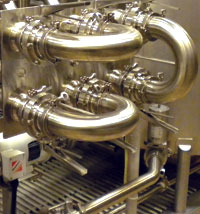
One option for providing an atmospheric break is a transfer panel. In the simplest version, three lines connect to a panel. A “U” shaped removable jumper, connects two of the three lines. The disconnected line now has an atmospheric break, while the connected line is in service. This concept can be extended to complex configurations of multiple lines and multiple jumpers.
While relatively low in cost and maintenance, these jumpers must be manually moved between lines, which is labor intensive and can cause mistakes due to operator errors. This process also exposes the operator to pressure, heat, cleaning costs and there is a greater chance of material loss.
Mix-Proof Valve Clusters
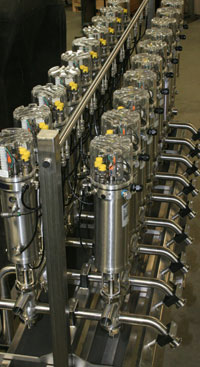
Another way to prevent contamination is by using mix proof valves to create an atmospheric break. Sanitary mix-proof valve manufactures provide a wide array of valve configurations that share a common feature: the atmospheric break is provided by the internal mechanism of the valve. For complex operations, clusters of valves can be combined to safely provide CIP solution and ingredients wherever they are needed.
While this method does involve a higher start-up cost and a more complex maintenance system, it is fully automated which removes the chances for operator errors and keeps operators out of harm’s way. Valves can be located away from operator areas, and all operations can be pre-programmed. Mix proof valve clusters have the added benefit of rapid change-overs. In many cases, mix-proof valve clusters more than pay for themselves by keeping employees safe and operations running automatically.
So which is better?
As you can see, both methods will get the job done by providing the key atmospheric break, and both can be adapted to more complex configurations. In either case, creative design will lead to the plant’s needs being met, so which is better? Ultimately the answer lies in the review process. When you work with Placer Process Systems, we will take into account all of your requirements including cost, timeline, available equipment and employee safety measures, and determine which method is right for you.
Quick Reference Guide
Transfer Panels
Pros |
Cons |
Relatively low cost |
Manual change over |
Operator can see flow path |
Possible material loss |
Jumper position can be monitored with proximity switches |
Operator exposure to pressure, heat, and chemicals |
Low maintenance |
|
Double Seat Valve Clusters
Pros |
Cons |
Rapid change-over |
Relatively high implementation cost |
Fully automated systems |
Complex system for maintenance |
No operator exposure |
|
Pre-programmed configurations |
|
Valves can be located away from operator areas |
|